Why Emergency Communication Matters More Than Ever
For millions of Filipinos, preparing for a typhoon means securing the roof, stocking drinking water, protecting important documents, and charging every available mobile device. Yet one essential part of emergency preparation can easily be overlooked: maintaining a reliable way to receive information and communicate when electricity and mobile networks become unavailable.
The Philippines faces recurring tropical cyclones, intense rainfall, flooding, landslides, and coastal hazards. According to the Philippine Atmospheric, Geophysical and Astronomical Services Administration (PAGASA), around 20 tropical cyclones enter the Philippine Area of Responsibility annually on average, with approximately eight or nine crossing the country. The peak of the typhoon season runs from July through October.
In October 2026, these risks remain especially relevant. PAGASA issued a bulletin for Super Typhoon Rosal on October 21, highlighting severe winds and potential hazards affecting parts of the country. Such developments reinforce the importance of following official weather advisories and preparing communication equipment before conditions deteriorate.
For households, barangay officials, rescue volunteers, and emergency response teams, communication is not simply about convenience. It can determine whether a family receives an evacuation warning, whether medical assistance reaches an isolated community, and whether residents understand what to do when roads become impassable.
Emergency radios, spare batteries, and backup chargers therefore deserve a permanent place in every practical disaster preparedness plan.
When Mobile Networks and Electricity Fail
Smartphones have become the primary information source for many Filipino households. People check weather updates, follow local government announcements, contact relatives, and monitor social media for reports from affected communities. However, these conveniences depend on functioning devices, available electricity, and accessible communications networks.
During a powerful storm, several problems can occur simultaneously. Floodwater may damage electrical infrastructure, fallen trees can obstruct roads and disrupt cables, and widespread power interruptions may affect telecommunications facilities. Even when mobile towers remain operational, heavy demand can make calls and data connections unreliable.
A depleted smartphone battery adds another complication. Residents may need their remaining power for emergency calls, location sharing, digital identification, or coordination with family members. Constantly refreshing social media or watching videos can consume valuable energy without providing useful new information.
This is where a battery-powered AM/FM radio becomes especially valuable. Unlike an internet-connected device, a conventional broadcast radio can receive transmissions without a mobile data subscription or a working home broadband connection. When local stations carry official announcements, listeners may continue receiving information even when their internet connection disappears.
Radio does not solve every communication problem. Reception depends on the station, signal conditions, location, and the condition of the receiving equipment. Nevertheless, it offers an additional channel that can complement smartphones and official emergency alert systems.
The objective is not to abandon modern technology. It is to avoid depending on a single system when a disaster can disrupt several services at once.
Emergency Radios Provide a Practical Backup
A basic emergency radio may appear less sophisticated than a modern smartphone, but its simplicity is a major advantage during an outage. A suitable portable model can receive local broadcasts, provide weather and public safety information, and operate independently of household electricity when equipped with a functioning power source.
For families in Metro Manila, a radio can help them follow flood advisories, transport disruptions, and evacuation announcements. In coastal provinces, fishing communities may benefit from timely weather information and warnings about dangerous sea conditions. In upland barangays, radio broadcasts can offer an alternative source of updates when landslides or damaged roads isolate residents.
Before purchasing a radio, buyers should consider which broadcast bands are available, whether local stations provide useful emergency information, and how the device is powered. Models supporting replaceable batteries may be practical for households that want to keep spare power supplies ready. Hand-crank or solar-assisted models can offer additional flexibility, although their charging performance varies and should not be assumed to meet every power requirement.
Reception quality also matters. A feature-rich device is not necessarily useful if it cannot receive a clear signal in the intended location. Test the radio indoors and outdoors, identify reliable local stations, and learn how to tune it without relying on online instructions.
Most importantly, households should turn the device on periodically. A radio that has remained unused in a storage box for two years may have corroded contacts, damaged controls, or exhausted batteries just when it is needed.
The Often-Overlooked Importance of Battery Readiness
Emergency equipment is only useful when it works. Although families may remember to buy a flashlight or portable radio, they sometimes forget to check the condition of the batteries that power these devices.
A radio communication battery intended for professional handheld radios may have different voltage, capacity, connector arrangements, and charging requirements from the batteries used in ordinary AM/FM receivers. Choosing the correct replacement is essential because a battery that physically fits may still be electrically incompatible.
Households using simple broadcast radios should check the manufacturer’s specifications and select the battery type recommended for their particular model. Teams operating two-way radios require even greater care because those devices may be essential for coordinating evacuation routes, search operations, and supply deliveries.
Battery maintenance should begin well before a storm approaches. Recharge rechargeable units according to their instructions, inspect contacts for corrosion, and store spare disposable batteries in a cool, dry place. Check expiry dates where applicable and rotate supplies rather than leaving them forgotten for years.
For rechargeable packs, avoid assuming that a device is ready merely because it was charged several months earlier. Self-discharge, temperature exposure, ageing, and the condition of the battery can affect how much usable energy remains.
It is also wise to keep batteries protected from water and physical damage. Floodwater can contaminate equipment, while damaged or swollen rechargeable batteries should not be used. Follow the manufacturer’s charging and storage instructions, and never attempt to recharge disposable batteries that are not designed for that purpose.
A small amount of routine maintenance can prevent a frustrating situation in which a radio is available but unable to operate.
Two-Way Radios Help Emergency Teams Stay Coordinated
Broadcast radios and two-way radios serve different purposes. A broadcast receiver allows people to listen to information sent by radio stations. A two-way radio allows authorised users to transmit messages as well as receive them, subject to the equipment, operating procedures, and applicable regulations.
This distinction is particularly important for local disaster response.
Barangay disaster risk reduction and management teams, rescue volunteers, medical personnel, and utility crews may need to exchange short operational messages when commercial communication services are disrupted. They might coordinate the location of a temporary evacuation centre, report a blocked road, request medical supplies, or confirm whether a particular area has been reached.
In July 2026, the Philippine Information Agency reported that the Department of Information and Communications Technology was strengthening emergency communications and digital connectivity in Cagayan Valley. The reported initiatives included emergency communication equipment, satellite connectivity, radio communications, and closer coordination among agencies.
Such efforts illustrate why emergency communication is a combination of equipment, planning, trained personnel, and reliable power. A radio cannot coordinate an effective response if operators lack agreed procedures or cannot reach the people who need assistance.
For professional teams, a compatible radio communication battery is an operational requirement rather than an optional accessory. A depleted handheld radio can interrupt an important exchange at a critical moment, particularly when responders are working in remote areas or difficult weather conditions.
Organisations should therefore establish equipment inventories, identify compatible spare batteries, schedule charging checks, and test communication procedures before deployment. Teams should also follow applicable radio licensing and frequency rules rather than assuming every device can communicate with every other unit.
Backup Chargers Keep Essential Devices Available
Although radios provide an important alternative, smartphones remain valuable during disasters. They can display digital maps, receive official alerts, share locations, store emergency contact information, and help families communicate when mobile services remain available.
A properly maintained power bank can extend the usefulness of these functions during a brownout. The most practical choice depends on the household’s needs, the number of devices, and how long an interruption may last.
Capacity is only one consideration. Buyers should also examine output compatibility, charging speed, build quality, safety protections, and the number of times the power bank can realistically recharge a particular device. Advertised capacity does not translate directly into the same amount of energy delivered to a phone because conversion losses occur during charging.
Families should charge power banks before severe weather arrives, keep the necessary cables together, and avoid using damaged products. During an outage, reducing screen brightness, enabling low-power mode, disabling unnecessary background activity, and sending concise text messages can help preserve energy.
A household with several people may benefit from assigning one power bank to emergency communications rather than allowing everyone to use it for entertainment. Phones should be charged when electricity is available, but residents should also avoid unnecessary exposure to electrical equipment in flooded areas.
Solar chargers can provide another option, especially when outages last for an extended period. However, performance depends on sunlight, panel size, weather, and charging compatibility. Heavy cloud cover and prolonged rainfall can limit solar charging, so solar equipment should supplement rather than replace a broader backup plan.
Preparing Communities Beyond Major Cities
Disaster preparedness is not equally easy for every Filipino household. Families in remote islands, mountainous areas, and geographically isolated barangays may face additional challenges when roads, bridges, power lines, or telecommunications infrastructure are damaged.
In these locations, preparation needs to reflect local conditions. Communities should identify which radio stations provide relevant advisories, where evacuation centres are located, and how residents can obtain assistance when normal services are interrupted.
Local governments and community organisations can help by arranging equipment checks, practising emergency communication procedures, and making sure warnings are understandable to residents. Information may need to be communicated in Filipino, English, or local languages, depending on the community.
Households should also consider residents who may need additional assistance, including older adults, people with disabilities, young children, and individuals who rely on electricity-dependent medical equipment. Emergency plans should identify how these needs will be addressed before a storm arrives.
Community communication plans work best when responsibilities are clear. Residents should know where to find official updates, which local authorities issue evacuation instructions, and how to report an urgent situation safely.
No single gadget can replace these arrangements. Reliable equipment becomes much more useful when people know how to operate it and understand what action to take after receiving a warning.
Building a Typhoon-Ready Communication Kit
A useful emergency kit does not have to be expensive or complicated. The aim is to assemble a small collection of equipment that can continue working when ordinary services are disrupted.
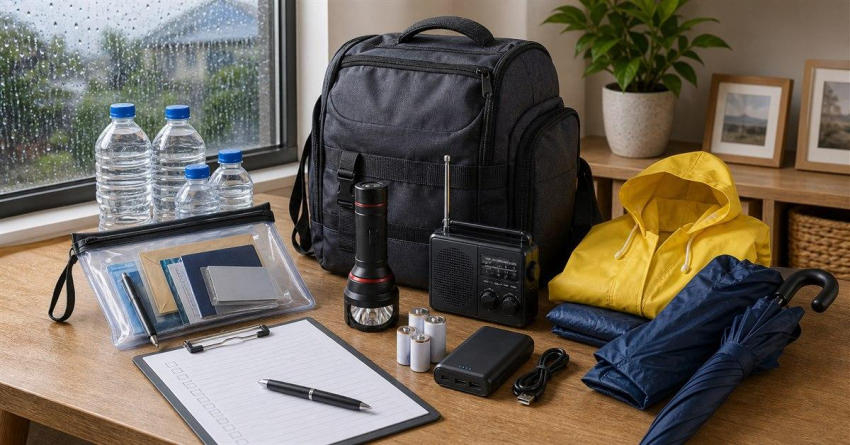
A household kit can include a battery-powered AM/FM radio, spare batteries compatible with the device, a charged power bank, suitable charging cables, a flashlight, and a written list of important phone numbers. Waterproof storage can help protect documents and small electronic items, although no container should be assumed completely waterproof unless it is designed and tested for that purpose.
Families should also keep drinking water, essential medicines, basic first-aid supplies, and enough food for the period recommended by local authorities. Communication equipment belongs within this wider preparedness plan, not in place of other necessities.
For teams using professional handheld radios, the checklist should include compatible spare packs, approved chargers, protective storage, and a way to identify which units are fully charged. A radio communication battery should be checked according to the manufacturer’s guidance, with damaged or ageing packs replaced when necessary.
Before a storm, test each device, confirm radio reception, charge essential equipment, and review the family’s evacuation arrangements. Once severe weather begins, follow official instructions and avoid travelling through floodwater or entering hazardous areas simply to obtain a better signal.
PAGASA bulletins, local government announcements, and guidance from the Office of Civil Defense should take priority over unverified social media claims. If information is uncertain, seek confirmation from an official source whenever possible.
Preparedness Starts Before the Warning Arrives
Typhoon readiness is often measured by the supplies people can see: food, bottled water, flashlights, and emergency bags. Yet the ability to receive accurate information and communicate with others is just as important.
For Filipino households, a simple radio can provide an alternative source of public information when mobile data becomes unreliable. A charged power bank can preserve essential smartphone functions, while properly maintained two-way radios can help trained response teams coordinate their work.
The most effective approach combines these tools with regular equipment checks, clear household plans, and attention to official weather updates. It also recognises that different communities face different risks and may require different communication arrangements.
As the Philippines continues strengthening disaster resilience, households do not need to wait for the next major storm to improve their preparations. They can start by testing a radio, charging essential devices, checking spare batteries, and agreeing on how family members will contact one another.
A storm may disrupt electricity, damage infrastructure, and interrupt familiar routines. Preparation cannot prevent every emergency, but it can help families make informed decisions when reliable information matters most.
In a country where severe weather is a recurring reality, staying connected is not merely a technological convenience. It is an important part of protecting lives, supporting communities, and ensuring that a warning can still be heard when other systems go quiet.