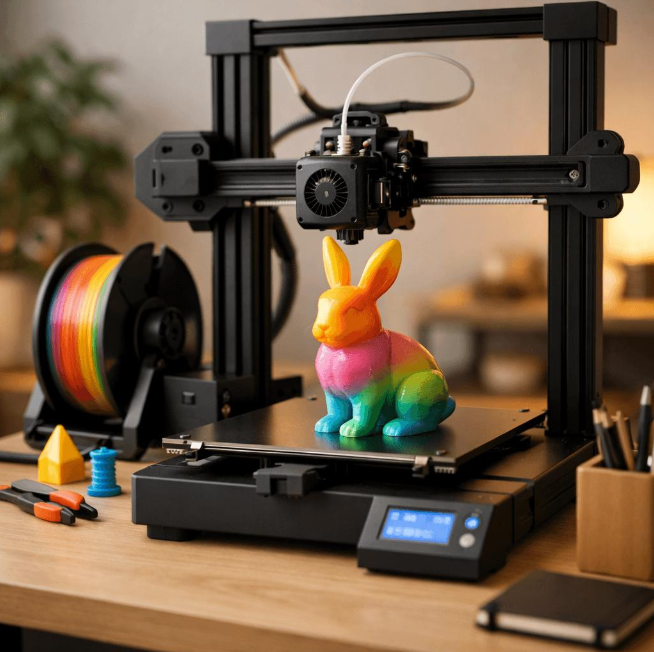
Imagine waking up on a Saturday morning with an idea for a cute dinosaur toy, a personalized phone stand, or a protective cable organizer. Instead of searching through online shopping platforms, comparing prices, and waiting several days for delivery, you simply open your computer, select a digital design, and let a machine create the object right in your home.
This is the exciting possibility offered by 3D printing. What once seemed like technology reserved for engineers, factories, and professional designers is gradually becoming more accessible to ordinary consumers. From customized toys to practical smartphone accessories, home 3D printing is changing how people think about shopping, creativity, and everyday products.
In the Philippines, where online shopping, mobile technology, creative hobbies, and small home-based businesses have become important parts of everyday life, this technology could open up particularly interesting opportunities. But how does it actually work, what can Filipinos make with it, and could having a small 3D printer at home eventually become as normal as owning an ordinary inkjet printer?
3D Printing Is Turning Digital Ideas Into Real Objects
Traditional printers put ink onto paper to produce photographs, documents, and illustrations. A 3D printer works differently. Instead of creating a flat image, it builds a physical object by depositing or solidifying material layer by layer.
The process usually begins with a digital model. Users can download an existing design or create their own using 3D modeling software. The design is then processed by a slicing application, which divides the object into hundreds or thousands of thin layers. The printer follows these instructions to build the finished item.
For many beginners, fused deposition modeling (FDM) is one of the easiest technologies to understand. It uses a spool of thermoplastic filament, which is heated and pushed through a nozzle. The machine deposits the melted material along a programmed path until the object takes shape.
Other machines use liquid resin and light to produce objects with finer details. These printers can be useful for miniature figures, decorative pieces, and intricate designs, although they require additional precautions when handling materials.
The most fascinating part is that the same machine can produce completely different objects. One day, it might create a small toy dinosaur. The next day, it could manufacture a customized phone holder or a replacement knob for a household organizer.
Instead of buying a different product for every small need, users can experiment with designs and make objects that match their preferences.
Why 3D Printing Is Becoming Interesting to Filipinos
The Philippines has a strong culture of online shopping, social media discovery, and personalized products. Consumers regularly look for phone accessories, collectible figures, desk decorations, and affordable gifts through digital marketplaces.
These habits create a natural connection with 3D printing.
A person who enjoys collecting cute figures might want a character-inspired decoration that is difficult to find in local stores. A student might need a phone stand that fits a particular desk arrangement. A small business owner might want customized display pieces for an online shop.
Instead of depending entirely on mass-produced designs, 3D printing allows people to explore more personal alternatives.
There are already signs of growing local interest. In June 2026, Philippine media outlet GMA News featured three friends who developed a 3D-printing business into an operation generating substantial monthly revenue. Their products included toys, souvenirs, decorative items, and customized creations.
Meanwhile, the Department of Science and Technology has continued promoting practical 3D-printing education. In September 2026, DOST-STII reported a hands-on training workshop that introduced senior high school students in Taguig to digital modeling and additive manufacturing.
These developments suggest that 3D printing is no longer just an interesting concept discussed in technology exhibitions. It is becoming part of conversations about education, entrepreneurship, and creative production in the country.
From Cute Dinosaurs to Personalized Action Figures
One of the most entertaining applications of home 3D printing is making toys.
Imagine having a collection of colorful miniature animals sitting on your study table. You could print a flexible octopus, a tiny dragon, a miniature robot, or a set of geometric building blocks. You could even experiment with different sizes and colors to create a collection that reflects your personality.
For children, the technology could make playtime more interactive. Rather than simply receiving a finished toy, they could participate in choosing its design, watching the printing process, and learning how digital ideas become physical objects.
Parents could also use simple educational models to introduce basic concepts such as shapes, measurements, engineering, and problem-solving.
For example, a child interested in dinosaurs might begin with a small printable dinosaur model. After becoming familiar with the process, the child could experiment with changing its dimensions, designing a different tail, or creating a dinosaur-themed miniature playground.
However, printed toys should be selected carefully. Small detachable pieces can present choking hazards for young children, while unsuitable materials or poorly finished surfaces may create additional risks. Toys intended for children should be age-appropriate, smooth, durable, and made from suitable materials.
Electrical toys require even more attention because their moving parts and power systems involve additional components.
Phone Accessories Could Become More Personal Than Ever
Smartphones are essential everyday devices in the Philippines. People use them for online payments, messaging, entertainment, schoolwork, navigation, and shopping.
Naturally, phone accessories have become a popular category of everyday purchases.
But standard accessories do not always meet everyone’s needs. A regular phone stand might be too short, a cable holder might not fit a particular charging cable, and a desk organizer might not have enough space for several devices.
A home 3D printer could help solve these small frustrations.
Users could create adjustable phone stands, personalized smartphone docks, headphone holders, charging-cable clips, camera covers, and decorative phone grips. Designs could be modified to fit different phone dimensions and personal preferences.
For example, someone who frequently watches videos while eating could print a stand with a wider viewing angle. A student attending online classes might prefer a compact phone holder that fits beside a laptop. Someone who works from home could create a desk organizer that holds a phone, charging cable, and wireless earbuds together.
The biggest advantage is customization.
A person could choose a favorite color, add initials, change the object’s dimensions, or create a design inspired by a hobby. These small details can make an ordinary accessory feel much more personal.
However, 3D-printed accessories should not automatically be considered protective equipment. A decorative phone case, for example, may not provide reliable drop protection unless its material, construction, and fit have been properly tested.
Could Home Printing Become a Small Business Opportunity?
For Filipinos interested in earning extra income, 3D printing could become more than a weekend hobby.
The business model is relatively straightforward. A creator develops or selects a digital design, prints the item, checks its quality, and sells it through online marketplaces or social media.
Potential products include personalized keychains, desk decorations, miniature collectibles, phone stands, customized gifts, and educational models.
The appeal of this approach is that small businesses can produce items according to customer demand instead of purchasing large quantities of ready-made inventory.
For example, an online seller could advertise personalized nameplates and print each one after receiving an order. Another entrepreneur might specialize in customized accessories for students, gamers, or motorcycle enthusiasts.
This approach could be particularly useful for sellers who want to experiment with different products without committing to large production runs.
Nevertheless, printing is not automatically profitable. Business owners need to consider filament or resin costs, electricity consumption, failed prints, machine maintenance, packaging, delivery, and the time required to finish each product.
Design quality also matters. A product that looks attractive in a digital preview might not be comfortable, durable, or practical when used in real life.
A successful small business therefore needs more than an affordable printer. It needs creativity, reliable production, and a clear understanding of what local customers actually want.
What About the Power Supply and Battery Requirements?
An important detail that beginners sometimes overlook is electricity.
Most home 3D printers are powered by an external electrical supply. Their heaters, motors, display screens, and control systems require a consistent power source throughout the printing process.
A small object might take less than an hour, while a complicated model can require several hours or even longer. If electricity is interrupted during printing, the machine may stop before the object is completed.
This is worth considering in the Philippines, where households sometimes experience power interruptions during severe weather or local electrical disruptions.
Some users may consider an appropriately rated uninterruptible power supply (UPS) to provide temporary backup power. However, the required capacity depends on the printer’s actual power consumption, especially the heating components. A UPS should be selected according to the manufacturer’s electrical specifications rather than simply its advertised runtime.
Batteries also become relevant when printed creations are designed as functional electronic toys. A motorized miniature car, an illuminated robot, or a programmable moving figure may require a compact power source. In these applications, choosing a suitable toys battery involves considering voltage, capacity, dimensions, discharge requirements, and compatibility with the electronic circuit.
Safety should always come first. Batteries must be properly matched to the device, protected against short circuits, and installed according to the manufacturer’s instructions.
A printed plastic shell alone does not make an electronic toy safe. Its wiring, switches, motors, and power components all need appropriate testing.
Is a 3D Printer Affordable for an Ordinary Household?
The cost is one of the biggest questions for anyone considering home 3D printing.
Although entry-level machines are more accessible than professional manufacturing equipment, purchasing a printer is only the beginning. Users also need materials, software, maintenance supplies, and enough space to operate the machine safely.
FDM printers are generally a practical starting point for people interested in everyday objects. They can produce phone stands, organizers, simple toys, and decorative accessories.
Resin printers are more suitable for certain highly detailed designs, but they involve additional handling requirements. Liquid resin should not be treated like ordinary household plastic, and users need suitable protective equipment and ventilation.
Another consideration is the learning curve.
The first few prints might not look perfect. Objects can become detached from the printing bed, layers may not align properly, and complicated designs can require adjustments to temperature and printing speed.
Beginners should start with simple models rather than attempting complicated mechanical toys immediately.
It is also worth comparing the cost of owning a printer with using a local printing service. If someone only wants a few customized keychains or a single phone stand, paying a printing business may be more economical than buying an entire machine.
Could 3D Printing Help Reduce Household Waste?
Another interesting possibility involves repairing and reusing everyday objects.
Instead of throwing away an entire organizer because one small plastic component has broken, a user might be able to print a replacement part. Missing knobs, clips, brackets, cable guides, and simple holders are examples of items that could potentially be reproduced.
This idea is especially relevant for households that want to avoid unnecessary purchases.
However, not every broken component should be recreated with ordinary 3D-printing materials. Parts exposed to high temperatures, electrical stress, heavy loads, or safety-critical forces may require specialized materials and professional testing.
Material waste is also something to consider. Failed prints, support structures, and leftover filament can accumulate over time.
Responsible users should select appropriate materials, avoid unnecessary test prints, and investigate local recycling options where available.
The environmental benefits depend on how the technology is actually used. Printing more plastic decorations simply because they are easy to make does not automatically create a more sustainable lifestyle.
What Should Beginners Print First?
For someone who has never used a 3D printer, the best approach is to begin with objects that are small, useful, and relatively easy to produce.
A simple phone stand is a good first project because it introduces basic dimensions and structural design. A cable organizer is another practical option, while a small articulated animal can demonstrate how different sections move together.
After gaining confidence, users can explore more complicated projects, including customized desk accessories, miniature buildings, educational models, and decorative collectibles.
It is also helpful to explore online design communities. Many creators share printable models, tutorials, and advice about improving print quality.
Before downloading a design, users should check its licensing terms. Some files are intended for personal use only, while others allow commercial production under specific conditions.
For parents, children should participate in age-appropriate design activities while adults operate the printer and handle heated components, chemicals, and other potentially hazardous materials.
The Future of Personalized Making in the Philippines
The most exciting thing about home 3D printing is not simply that it can produce toys and phone accessories. It is that it changes the relationship between consumers and the products they use.
Instead of choosing only from what stores have available, people can experiment with their own ideas. Students can turn classroom projects into physical models. Hobbyists can create personalized collectibles. Small entrepreneurs can test new product concepts without investing in traditional manufacturing equipment.
As access to digital design tools, printing services, and practical technology education continues to develop in the Philippines, more people may discover that creating something themselves is just as exciting as buying something new.
There will still be limitations. Printing takes time, materials have different strengths, and some products require professional manufacturing standards. A home printer cannot replace every factory or produce every kind of object.
But it does not need to.
Imagine a future where a Filipino student designs a customized phone stand after class, a parent creates a simple educational toy for the weekend, and a small online seller produces personalized gifts from a home workspace.
Even electronic creations could become more ambitious. A customized robot or interactive toy might combine printed parts, small motors, sensors, and a suitable toys battery to bring a digital design to life.
That is the real attraction of this technology: it gives ordinary people more opportunities to turn imagination into something they can touch, use, share, and potentially sell.
Perhaps the next exciting toy on your desk or the next clever accessory beside your smartphone will not come from a shopping mall at all. It might come straight from your own 3D printer.